
Published on 21st April 2026
Introduction
The UK’s EU Rejoiners have been quick to celebrate the landslide victory of Peter Magyar’s Tisza Party in the recent Hungarian election, displacing Viktor Orban, his EU-sceptic predecessor and bête noire of all progressive humanity.
This celebration is part of the chorus line encouraging the current UK government to rejoin the EU, and quickly, in a Leftist shoo-in process without going through any troublesome democratic dance steps.
Cambridge University as the ultimate Rejoiner organ – https://www.cam.ac.uk/stories/hungarian-election-2026
Cambridge University was quick to publish a gushing reaction to the election result in the form of a eulogy claiming that ‘Hungary’s 2026 election represents a pivotal moment for the country with far-reaching geopolitical implications’. Does it have ‘far-reaching geopolitical implications’? Their ilk would like to think so, and to claim this as a turning of the tide away from the dreaded ‘populism’ and towards federalist, technocratic, enlightened centralism i.e. towards greater power for people like themselves, and less power for everyone else.
The contributors were ‘Four Cambridge researchers’ and ones ‘with close academic and personal ties to the country’. Their brief was to ‘discuss how we got here, what the result means, and what the future might hold’. Their contributions were repetitive of one another, as if many people echoing the same claims renders the claims automatically correct. The contributors’ individual offerings did not provide evidence for the claim that the result has major implications outside Hungary. This kind of exaggeration by repetition, and failure to add any depth of evidence behind sweeping assertions, is a form of fake news. It is a frequent feature of the writing-up of events that can be cast as endorsing the EU, illustrated by Rejoiners chorusing the claim that Brexit cost the UK 8% of GDP, without bringing any evidence that the claim is true, or even being able to explain the claim itself.
Over-billing of the contributors
On closer examination this line-up of star academics was less impressive than its billing portended. One would expect four distinguished figures. The billing inferred all four had both types of tie – academic and personal – to Hungary, and that the ties were all ‘close’: eight instances of close ties in all. In reality some had academic ties, and some had personal ties, but none seem to have both. In fact, one appeared to have neither. Even of the ties that did exist, there was no evidence presented that they were close, except in the inference that the two who had recognisably Hungarian names also had close personal ties to the country. Donald Trump has a recognisably German name but does not have close or indeed even tenuous personal ties to the country.
Only the one first featured – Professor Nora Berend – was senior, and at first blush relevant: a Professor of European History and with books about Hungary. However, her books on subjects such as At the Gate of Christendom: Jews, Muslims and ‘Pagans’ in Medieval Hungary c. 1000- c. 1300, and Stephen I, the first Christian king of Hungary: from medieval myth to modern legend indicate a time focus no nearer than 700 years in the past.
The subject area of the second one – Dr Marietta van der Tol – is Divinity and she is neither senior nor involved in a relevant subject. Indeed she has a Dutch name, took her first degree at the University of Utrecht, and has since been engaged at Yale, Oxford and Cambridge, so it is not clear what her personal ties to Hungary consist of. Her academic tie appears to boil down to an aversion to ‘populism’.
The third one – Elvira Viktória Tamus – is a PhD researcher (not senior), but in History, which could be relevant, dependent upon the exact focus, which is not disclosed. The final one – Dr Barnabás Szabó – is a post doc research associate (not senior), at the Centre for Geopolitics, which is relevant, dependent upon the exact focus, which is not disclosed. Only these two – with recognisably Hungarian names – might have a close personal tie to Hungary. They may also have an academic tie: it is inferred but not stated. Were it to exist, one imagines it would be stated. The lack of clarity points to its not existing or its being weak. These two are also the least senior.
Such details as seniority, the reality and strength of connections, and the relevance of study areas, are swept aside in the orgasmic enthusiasm to draw the correct, EU-friendly conclusions of Orban’s defeat. This drafting technique – bigging up the nature and significance of source material – would not be acceptable in a thesis or exam script directed towards Cambridge University, but it appears to be perfectly acceptable for Cambridge University to employ it in directing its institutional world view (‘Weltanschauung’) outwards at the wider world.
What can Hungary expect out of its new bromance with the EU? Firstly, money
The Tisza manifesto makes a big play about the EU having held back €30 billion due to the Orban government’s backsliding on EU laws, regulations, and directives. Magyar intends to work at pace with EU officials to agree a pathway for realignment with EU laws, regulations, and directives, and for the step-by-step release of funds. Naturally the EU will be the determining agency in deciding the degree of Hungary’s realiagnment and whether funds should be released, and Magyar has submitted Hungary to that. Hungarian history has included many such phases of deference to diktats from foreign capitals. Vienna (notwithstanding the ‘Ausgleich’ or ‘kiegyezés’ of 1867) and Berlin acted in the past as Great Helmsmen over Hungary’s fate: why not now Brussels, with Frankfurt waiting in the wings, getting foreign hands on the tiller?
Increasing cost of EU membership
According to Politico, €10 billion of the blocked funds are coming from the Coronavirus Recovery Fund (aka NextGeneration EU), which must be drawn by the end of August this year.
Hungary should enjoy that money while it lasts, or, to employ prudency, hold onto it to meet the bills that will be coming its way. As from 1/1/2028 the debts taken on by the European Union to raise the Coronavirus Recovery Fund money start to fall due for repayment. Payments begin during the 2028-34 EU budget period, or Multiannual Financial Framework, and continue through its next three or four iterations.
The cost of EU membership is set to increase sharply from 1/1/2028 on account of the Coronavirus Recovery Fund debts for two reasons:
- over half of the money was given out as grants, which ensures that the EU will have a shortfall of over half of the repayment amount. The grants amount will be added, one way or another, to the member states’ payments under the 7-year Multiannual Financial Framework;
- fraud, mismanagement, and debtor failure will cause a further shortfall under the loans portion, even though there is – on paper at least – a debtor who is obliged to pay money back to the EU in an amount that covers the debt service on the like of amount of debt taken on by the EU.
Coronavirus Recovery Fund debts are ‘shadow debts’ of EU member states
The debts taken on by the EU for the Coronavirus Recovery Fund are typical ‘shadow debts’ of EU member states: taken on by EU supranational entities like the European Union, the European Stability Mechanism, the European Financial Stability Facility, and the European Investment Bank, and being the responsibility of member states, but not included in Eurostat measures of member state debt, like General Government Gross Debt.
The debt service relating to the Coronavirus Recovery Fund will be drawn from member states in the form of new levies and taxes that qualify as the EU’s ‘own resources’, and higher member state cash contributions to top up the difference between requirements and what EU businesses and individuals can be made to pay directly, through the tax-driven increases in the prices of goods and services.
Inflation for consumers: deflation for the overall economy
These increases are inflationary to consumers of goods and services, but deflationary to the economy as a whole, as the funds are drawn out from the consumers to be paid over to international investors.
The Coronavirus Recovery Fund is a typical Keynesian scheme aimed at providing a sugar-rush of economic growth in the short term, at the price of a deflationary impact in the medium term. The theory is that the economic growth caused by the stimulus will deliver the tax revenues to repay the debt that enabled it and more.
Like the preceding EU scheme of this type called InvestEU, however, the stimulus has failed to unleash sufficient growth and now the debt repayments will simply be added to the cost side of the equation.
What can Hungary expect out of its new bromance with the EU? Secondly, the euro
There are enough statements in the Tisza manifesto for Peter Magyar’s government to present itself as having a mandate for the forint to join the euro without a further consultation of the Hungarian electorate. None of the Cambridge contributors mentioned the euro issue by name. Professor Berend came closest to a euphemism for it by writing that ‘Hungarians seized the chance to…choose Europe’.
The table below contains all the mentions of the exact word ‘euro’ in Tisza’s 2026 election manifesto. The words ‘We are preparing for the introduction of the euro and implementing it with a foreseeable target date’ can in due course be clarified by Tisza politicians as having meant ‘we intend to join the euro before the next election’. The interpretation error can be placed on the electorate for having misread the mainfesto, when the true state of affairs belatedly gains prominence, as opposed to politicians being blamed for duplicity. There is only a certain degree of doublespeak and obfuscation about Tisza’s intentions once elected: far less than the work of fiction that was the wording of the UK Labour Party’s 2024 manifesto wording about the scope and depth of its intended EU Reset.
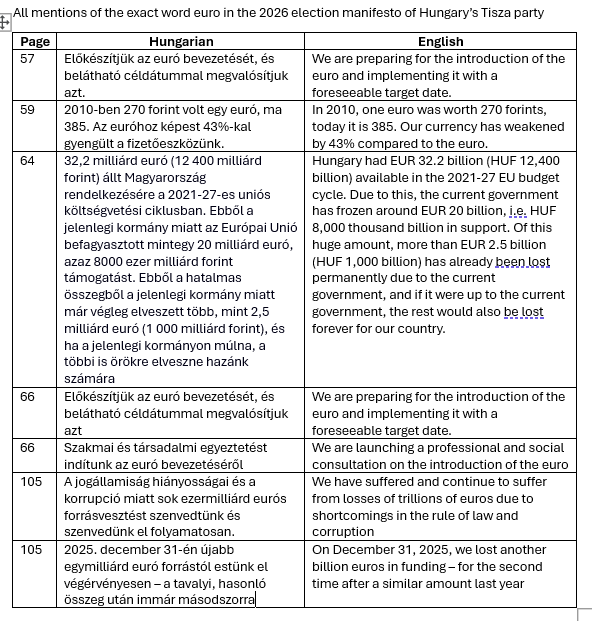
Four mentions of the topic in a document of 243 pages may not seem to do justice to a decision of enormous significance but that is not the point – the Tisza manifesto provides cover for Magyar to drive forward.
Sham consultation
A review about euro membership was announced by Magyar during the week after he had been elected. Tisza can now control the scope of, participation in, and conclusions of the ‘professional and social consultation on the introduction of the euro’ referred to on p. 66 of the manifesto.
The process will be put in the hands of Europhile technocrats who will be making sure that the methodology and data will be such as to deliver a positive outcome. Only ‘experts’ will be involved, and suitable experts can be selected on the prime criterion of their being known Europhiles.
The ‘consultation’ process can be done-and-dusted by Christmas 2026, and will give the go-ahead.
Transition into the euro
This will prepare the way for the forint to be admitted into ERM2 – the euro waiting room – alongside the Danish kroner on 1 January 2027.
A two-and-a-half-year convergence period would permit a switchover in June 2029 – nine months before the expiry of Magyar’s term-of-office. Hungarian note and coin can be withdrawn in June 2029: the dual circulation for euro and legacy currency note and coin has already been proven to be unnecessary.
There can still be a period when the euro amount of bills and invoices can be accompanied, in smaller type, by what was originally called Euro-Related Information: the legacy currency equivalent of the euro amount calculated at the irrevocably fixed exchange rate.
That period should be kept short so that people cease to notice how much prices have increased compared to what the same goods and services used to cost in forint.
The technical and practical steps towards euro adoption now tread a well-worn path.
Business case for euro adoption condensed into a single point
There should, though, be a well-considered business case and a realistic cost/benefit analysis. However, in the Tisza manifesto, this has been reduced to a single bullet point: ‘In 2010, one euro was worth 270 forints, today it is 385. Our currency has weakened by 43% compared to the euro’.
The inference is that Hungary has lost out significantly by not being part of the euro.
What the manifesto does not say is that joining ERM2 this year and converting to the euro in 3 years’ time would guarantee an irrevocably fixed exchange rate around the level the forint stands at today. If today’s rate is regarded as bad, why lock it in for ever?
Moreover, without safety valves like a floating exchange rate, control of interest rates, and control of the money supply (all ceded to the European Central Bank in Frankfurt), an entry at an adverse exchange rate is bound to import a painful bout of inflation (to add to the inflation caused by higher EU membership dues).
Tiny, inconvenient details like this can expect to merit no more than a footnote in the Europhiles’ ‘professional and social consultation on the introduction of the euro’.
Conclusions
Cambridge University and all other Rejoiners and their Europhile counterparts worldwide are cock-a-hoop at the election victory of Peter Magyar’s Tisza Party. The Hungarian electorate will be expecting the floodgates of EU money to now be thrown open: a Danube of cash cascading through Budapest.
The Danube may, however, start to flow upstream as from January 2028 when the cost of EU membership escalates sharply so that the debts taken on to finance the Coronavirus Recovery Fund can be repaid.
And then Hungary will convert to the euro during the Magyar’s current term-of-office, without the tiresome need for a referendum or any other ‘populist’ mechanism to gain electors’ approval. Hungary will enter the eurozone at around the worst exchange rate imaginable, and irrevocably.
We will see, subsequent to the economic and social damage this step causes, what the Europhiles and Rejoiners have to say for themselves. It will be too late by then for the Hungarians to say anything.