
Published on 14 May 2026, and as previously published on 12 May 2026 by Conservative Post
Introduction
Cambridge University recently announced a donation of £190 million for the establishment of ‘The Rokos School of Government’.
Its published aims are to ‘prepare future leaders to be able to navigate the ever-more-challenging demands of both domestic and international politics in a new and complex world of great structural change’.[1]
The UK’s academic, cultural and political elite have warmly welcomed this donation, temporarily overlooking its source: they love money, of course, especially when all they have to do is to lease the name ‘Cambridge University’ to something and the rent rolls in.
The rest of us should be rising up in outrage, because this will be a finishing school for the UK and global ruling class, and concentrate even more power into their hands.
Source of donation
Now we get a Rokos where we previously had a Soros.
Chris Rokos is the billionaire founder of an investment fund or hedge fund, engaged in the same kind of trading as the one run by George Soros which reportedly made US$1 billion betting against the £sterling on Black Wednesday.[2]
Rokos’ fund – Rokos Capital Management – bets on stock and bond markets, including on UK gilts.[3] This is the kind of fund which makes killings around events like the Mini Budget in September 2022 or the outbreak of the Iran war. It is a type of ‘shadow bank’, the class of market actor about which the Governor of the Bank of England raised concerns in a recent interview with Reuters.[4]
Having made their fortune, such people seek to influence UK public affairs, using their money, status, and access, so as to magnify their power beyond the one vote they are entitled to in an election.
Mr Rokos has managed to bet on gilts, and other traded assets, successfully, and not necessarily to the benefit of the UK, Joe Public, or anyone else apart from himself. That’s fine, it’s a free country. But why do his resulting riches entitle him to help formulate how the UK, Joe Public, and anyone else are governed?
What it is for
The Rokos School is intended to be ‘a place where leaders and governments – both current and future – together with experts from across our institution generate the insights and solutions needed to respond to our rapidly changing world’.
Are not politicians supposed to do this in election campaigns and ask the electorate to choose the version and the solutions the electorate wants?
The Cambridge Vice Chancellor’s view is that ‘Tackling the enormous challenges facing our world requires radical new ways of thinking and approaches to leadership’.
That is an interesting view: that all countries face the same problems, and must adopt the same public policy responses to these problems, and the ones designed in this college. One cannot have a situation where one country adopts a different public policy response to the same issue. This is the globalist view of course, that globally homogenized solutions are the only approach, to implement which (naturally) global institutions are required, staffed with globalist technocrats.
That sums up the approach that has been adopted since the Second World War, the period during which these ‘enormous challenges’ have emerged.
Who gets a say
These ‘radical new ways of thinking’ will be the province of a hedge-fund-financed college, at which only ‘leaders’ can participate.
Should they not be the province of inclusive public debate?
The Vice Chancellor’s response would be no: ‘Cambridge, with its strengths across all disciplines and its convening power, is uniquely positioned to drive this innovation’.
In other words, Cambridge has status and power, and an exclusive cachet, and solutions need to be designed within its closed confines and by those deemed worthy of admission.
What sort of graduates is this ‘school’ likely to produce?
What might the output of this college be with its ‘direct access to Cambridge’s renowned expertise in technology and the sciences, together with disciplines more usually associated with the social sciences, arts and humanities’?
Input + Process = Output.
The Input [leaders and governments – both current and future] get subjected to the Process [indoctrination delivered by ‘experts from across our institution’].
The Output – Leftist, Guardian-reading, UniParty, Remainer, elitist, globalist, technocratic, managerialist nomenklatura.
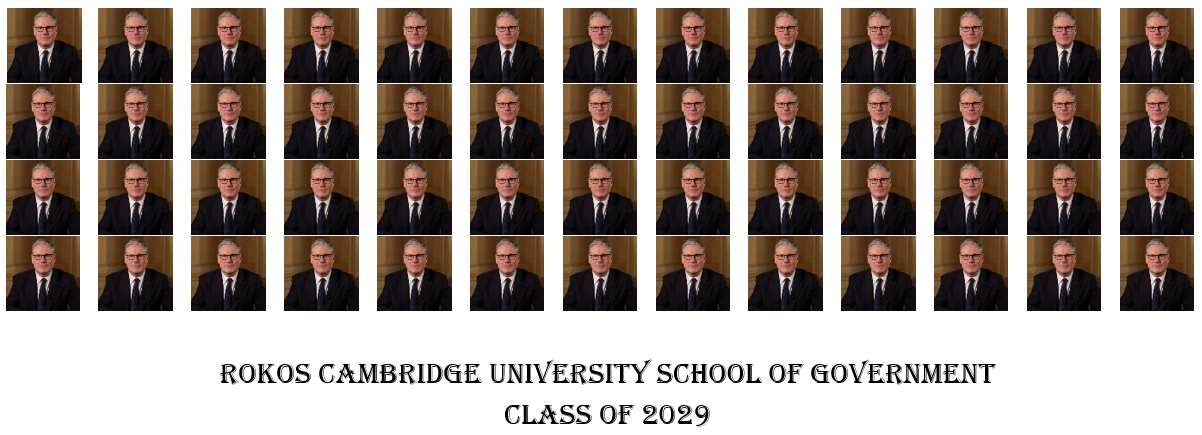
Starmer raised to the power of n.
This is the precise opposite outcome to the one desired by Joe Public.
International parallels
We are looking at a UK and global parallel to the French École nationale d’administration, the elite college that produces France’s politicians (regardless of their supposed party allegiance), jurists, senior business leaders, MEPs, EU commissioners, academics, civil servants, diplomats, and delegates to the management of EU institutions (the ECB, EIB, ESM etc.) and global institutions (World Bank, IMF, United Nations etc.).
The 1% sitting within this magic circle rule the remaining 99%, hapless and voiceless citizens consigned to their arrondissements.
Looking at the French societal and economic model and the way it has run itself into the ground, it is not solutions that are being generated by the graduates of this school – the so-called Énarques – but the original problems and the repeatedly failing attempts at resolving them.
Why is the same not the case at the UK and global level? Why should the ‘insights and solutions’ needed to ‘tackle the enormous challenges facing our world’ emanate from the same played-out elite who have managed the world into these problems in the first place?
Who decided on this
Naturally this is decided upon between two nominally distinct constituencies whose separation dissolves within the magic circle: they are exemplars of the circle’s Money department (Rokos) and its Status department (Cambridge University).
Who was not asked their opinion
This goes ahead without the inconvenience of consulting Joe Public – or Joe Public’s elected representatives – as to whether Joe Public wishes this college to exist, or to work on problems besetting Joe Public on which Joe Public might have and wish to express their own view, and have that view become public policy.
This is an important point that was illustrated by Brexit: Brexit was portrayed by the UK’s cultural elite as too important and complex an issue of public policy for Joe Public to be allowed to hold and express an opinion. When Joe Public voted Leave, the UK’s cultural elite labelled Joe Public as a racist moron, and have attempted ever since to have the result cancelled, or delayed, or over-turned, o – to give it its current name – re-set.
This new college will arrogate to itself the role of formulating opinions on public policy issues and of socialising them and disseminating them within the ruling elite – in the UK and globally. These opinions can then be crystallised into policies to be put to electorates, or even better, to use the elite’s preferred toolkit for dealing with electorates: ignoring the views of Joe Public, or undermining them once expressed, or, even better, finding ways of not seeking electorate approval at all.
Money, status and power
What we are looking at here is a further power grab by the global elite, using their levers over Money and Status to enable it. Whether this college is established or not, and, if it goes ahead, what it does, need to be subjected to democratic control.
The way the proposal has developed up to now is a good example of a bigger problem besetting global society: the increasing concentration of power outside the line of accountability to the electorate. That needs to be combatted, not encouraged.
Conclusions
The globalist, managerialist, technocratic, elitist nomenklatura should not be permitted their own finishing school. The proposal is a self-interested alliance of global finance in the shape of a hedge fund that – inter alia – speculates in UK government bonds, and the arrogant, self-contained, self-referencing, and self-absorbed Cambridge University. It would cause still greater concentration of power outside the line of accountability to the electorate, and into the 1% who have both given rise to the problems the proposal aims to address, and failed to solve them despite their ever-widening grip on power.
[1] https://www.cam.ac.uk/stories/rokos-school-of-government accessed on 11 April 2026
[2] https://www.investopedia.com/ask/answers/08/george-soros-bank-of-england.asp
[3] https://www.rokoscapital.com/#about
[4] https://www.reuters.com/sustainability/boards-policy-regulation/boes-bailey-invokes-2008-lessons-amid-private-credit-scrutiny-2026-04-01/