
Published on 19 October 2026
Introduction
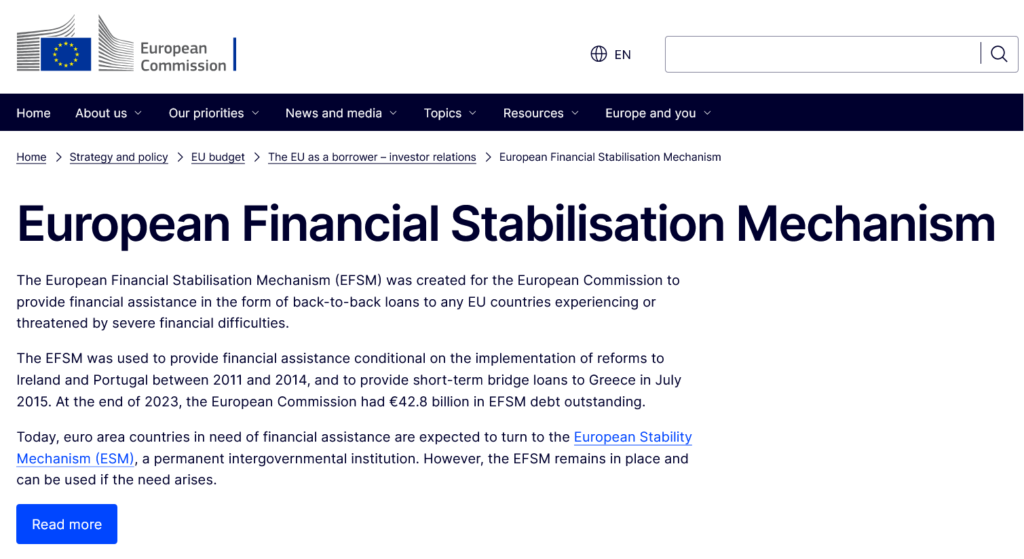
The European Financial Stabilisation Mechanism, or EFSM, ‘remains in place and can be used if the need arises’.
The EFSM is a scheme that runs through the European Union, just like the Coronavirus Recovery Fund (now re-named as Next Generation EU).
Because it runs through the EU and its budget, all EU member states automatically stand behind it.
This is why it is the only option for mounting a bailout of France.
The other options – the European Financial Stability Facility, the European Stability Mechanism, and the European Central Bank’s Transmission Protection Mechanism – are either closed, or lack the firepower, or do not qualify for usage as a bailout mechanism.
You can download our full paper on this topic here.
The real problem is that France will need a facility of €2 trillion, and that will come on top of the EU’s own debts which, with the mobilisation of the Next Generation EU programme and other facilities, look set to hit €1 trillion by the end of 2026 and €1.2 trillion by the end of 2027.
A 2-year bailout programme for France across the books of the EU would leave the EU with debts of over €3 trillion, with rating agencies and financial markets looking to Germany as the main backing – at a time when Germany’s own borrowing is rising sharply.
A French bailout would also require French support to be backed out of the calculations of the EU-level institutions that borrow: the European Financial Stability Facility, the European Stability Mechanism, and the European Investment Bank.
The rationale for the separate legal personalities of these institutions disappears and they should also be collapsed into the EU, adding a further €700 billion to the EU’s debts.
This amounts to a systemic crisis: the EU financial system cannot survive a bailout of France in its current form.