
Published on 12 October 2026
Introduction
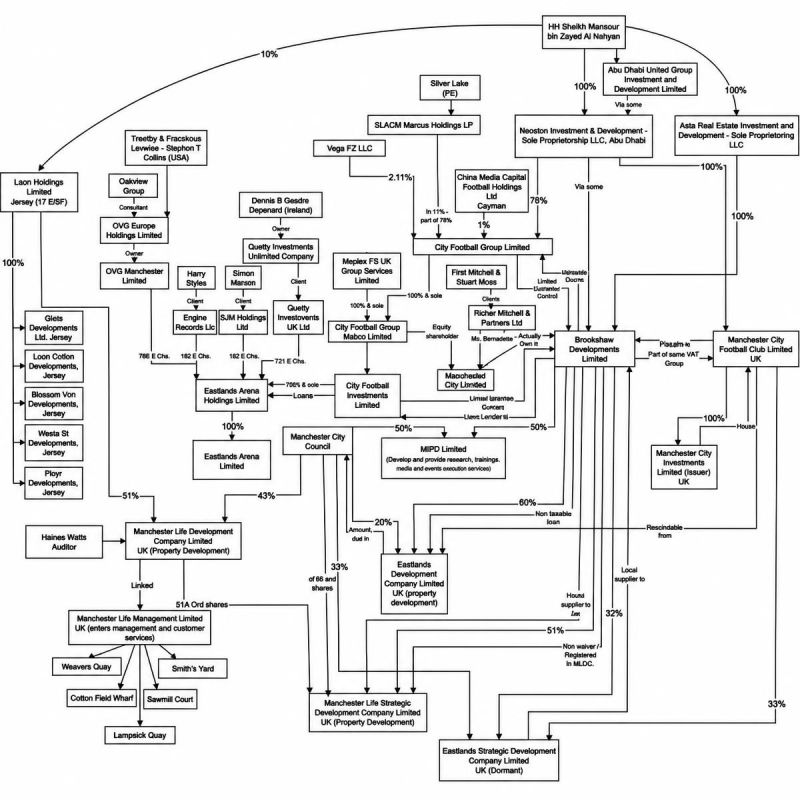
Manchester City stand accused of working with associated enterprises, all under the ultimate ownership of the rulers of Abu Dhabi, to make their Profit and Loss account look better than it ought to, were all of its dealings with these associated enterprises to have been recorded, and transacted on arm’s-length terms.
Similar techniques are used within Ireland’s ‘Celtic Tiger’ business model, whereby subsidiaries of (mainly) US-based multinationals manage to concentrate their international profits in an Ireland-incorporated subsidiary, and then pay corporation tax on the profits at an effective rate of 4%.
Blog from February 2024
We wrote up the inner workings of the extraordinarily successful Irish ‘Celtic Tiger’ business model in this blog in 2024:
https://www.lyddonconsulting.com/the-celtic-paper-tiger/
Alternatively you can download the paper through this link.
Who is damaged by the Irish and the Manchester City models
Ireland deprives other EU member states (and further countries) of corporation tax receipts, and of the wherewithal to sustain the infrastructure and services needed for the local subsidiaries of the same US-based multinationals to run their businesses in those EU member states.
The losers out of the Manchester City model are many and various, and it may take some time for the full trickle-down effect of this scandal to be realised by those who have been damaged by it.
Intercompany dealings – the key to both models
The organigram of enterprises associated with the Manchester City footballing company is extensive, and there will be wide trading between the enterprises in it. In principle these dealings should be conducted on arm’s length terms, meaning at the same price and with the same commercial conditions as would be agreed between two unrelated parties for the delivery of the identical product or service.
The integrity of these rules in practice depends on the presence of several factors, including:
- the ability to determine a proper arm’s-length arrangement where the quantity is not widely and openly traded, such as in the case of royalties for patents, image rights, and other intellectual property;
- the motivation of authorities to enforce the rules, which falls short in low- and zero-tax locations (‘sunny places with shady people’) and in other jurisdictions where benevolent tax and legal treatments are part-and-parcel of an officially-sanctioned scheme to attract the business of multinationals (on the basis that the government there booking tax revenues amounting to 12.5% of something is better than its making 30% of nothing).
Where factors are absent, and particularly where an accumulation of them is absent, it is possible to put together an attractive scheme. All the better for Ireland, as a member of the European Union, where the Treaty on the Functioning of the European Union (2016/C 202) guarantees that the parts of the scheme happening between Ireland and other EU member states cannot be challenged by the member states who are losing out.
Ireland – debiting of intercompany charges
A core part of the Ireland scheme is that intercompany charges levied on the Irish subsidiary by its sister companies can be deducted from its operating profit. These sister companies are resident in places like Panama, the Netherlands Antilles, and the British Virgin Islands: places where corporation tax is levied at rates of between 0% and 2%.
Having already shifted the non-US international profits into Ireland, a major chunk of them is then shifted again, into a low- or zero-tax jurisdiction. Effectively these revenues pass tax-free into the sister company in the low-tax jurisdiction.
Do the Irish tax authorities ever challenge these deductions for being too high, and for not being transacted on arm’s-length terms? They might, if the Irish company were to make a loss, and did not pay its Irish tax at 12.5% on something. But as long as the Irish company reports the pre-agreed level of profit and pays the pre-agreed amount of Irish corporation tax, everyone who has any say in the matter is happy.
Generous intercompany charges represent the first diminution of the operating profit being earned by the Irish company, of about 33% of it.
Aircraft leasing
Irish companies are permitted to act as the equity partner in a Limited Liability Partnership that buys an aircraft. The normal arrangement is that the equity partner inserts 15% of the aircraft’s cost, and that the Limited Liability Partnership borrows the remainder itself.
Despite only inserting 15% of the aircraft’s cost, the equity partner can use all of the depreciation allowances available on the aircraft, and reduce its operating profit for tax purposes accordingly.
The equity partner, through this device, obtains a depreciation allowance of 12.5% of the aircraft’s cost every year for 8 years, down to a zero residual value.
For an aircraft costing US$200 million, the equity partner pays in US$30 million, and every year receives a voucher for US$25 million that it can use to reduce its taxable profit, and to spare itself 12.5% tax on that profit. The voucher is therefore worth US$25 million x 12.5% = US$3.125 million per annum in tax savings. The equity partner also eventually gets its US$30 million back.
The aircraft is leased out of the Limited Liability Partnership either directly to an airline, or else to a leasing company than on-leases the aircraft to an airline. 70% of the world’s commercial aircraft fleet is owned by Irish Limited Liability Partnerships. This gives some idea of the scale of depreciation allowances that these US-owned Irish companies are obtaining to use to reduce their taxable profits, and of the profits themselves.
This is the second diminution of the operating profit of the Irish company, again of about another 33% of it.
Irish corporation tax
Irish corporation tax is then levied at a rate of 12.5% on the remaining 33% of the original operating profit, after it has been diminished by the inflated invoices presented by sister subsidiaries, and by the depreciation allowances the Irish subsidiary obtains through investing in a business outside of its main activity.
The taxable profit is only 33% of the original operating profit, having been diminished by 66% through these sleights-of-hand.
If the original operating profit was US$10 million, it is diminished to US$3.33 million. The corporation tax is 12.5% of this diminished amount: it comes out to US$416,250, just over 4% of the original operating profit.
That is the meaning of an ‘effective’ tax rate of 4%: the tax is 12.5% of the declared profit, but only 4% of the original operating profit.
Comparison with Manchester City
Both sets of techniques seek to manipulate the profit/loss made in a single legal entity that is either subject to Irish corporation tax, or to the English Premier League’s Profit and Sustainability Rules (previously known as Financial Fair Play).
Both sets of techniques use the manipulation of the pricing and commercial terms of intercompany business to achieve their aims.
Ireland’s techniques seek to diminish profit firstly in other countries where its clients trade, and secondly in the company established in Ireland that acts as the fulcrum of the scheme. 12.5% of something levied on the profit declared by this company is better than 30% of nothing, this nothing being the tax collected by the revenue services of countries like the UK, France, Germany, Spain, Italy, and many, many more. Profit is ultimately shifted into jurisdictions with zero or very low corporation tax rates, like Panama, the Netherlands Antilles and the British Virgin Islands.
Manchester City’s techniques seek to diminish expenses and boost revenues in the Profit and Loss account of an entity that is subject to Profit and Sustainability Rules. This is detrimental to other clubs who are bound by the same rules.
They are both examples of ‘financial engineering’ aimed to achieve selfish benefits to the detriment of others.
Sanctions on Manchester City
There is much speculation about what sanctions may be imposed on Manchester City. City’s own TV channel does not speculate, and they dismiss the possibility of the failure of their inevitable appeal, and that any meaningful punishment will be made to stick on them.
City may be looking at major fines, deductions of points, relegation from the English Premier League, disbarring from European competitions, expulsion from professional football, an enforced change of ownership, outright closure, or a mixture of the above.
It has to be severe, given the scale and longevity of the rule breaches.
Sanctions on Ireland
Ireland has become a master of the same financial manipulations as Manchester City has been proven as practising in their chosen sphere.
However, Ireland appears to be beyond the reach of any authority.
Expulsion from the EU would be a punishment fitting the crime, as the entire edifice would be unthinkable without Ireland’s being a full EU member. A halfway-house of relegation to some form of Associate membership status of the EU, as has been mooted for Canada, might seem less draconian, albeit that this status is as yet undefined and major obstacles stand in its way.
Expulsion from the EU or relegation to Associate status would entail expulsion also from the usage of the euro. That could set a dangerous precedent: if it could be arranged for Ireland, other Eurozone member states might be keen to join them. This is also a risk with the Associate member status: if it comprises an attractive package for Canada, existing full members of the EU might want to go for it as well.
Summary and conclusions
The Celtic Tiger is the source of Ireland’s wealth. That wealth is not created but garnered at the expense of others, mainly the other EU member states.
Having benefitted from an EU financial assistance package in 2008, when its previous boom based on real estate blew up in its face and took its banking system down with it, the thanks Ireland has extended to its financial supporters has been to turbocharge its status as a parasite on the other EU member states and to eat their lunch, dinner, breakfast, and any snacks in between.
The EU has no effective tools to kill off this parasite, and it has now grown to epic proportions. Even modest punishments would, in public, be violently decried by Irish politicians, all the while as they laugh up their sleeve on their way back to Dublin to carry on as before. Who is the imperial power now, and who is the colony?