
Published on 7 October 2026
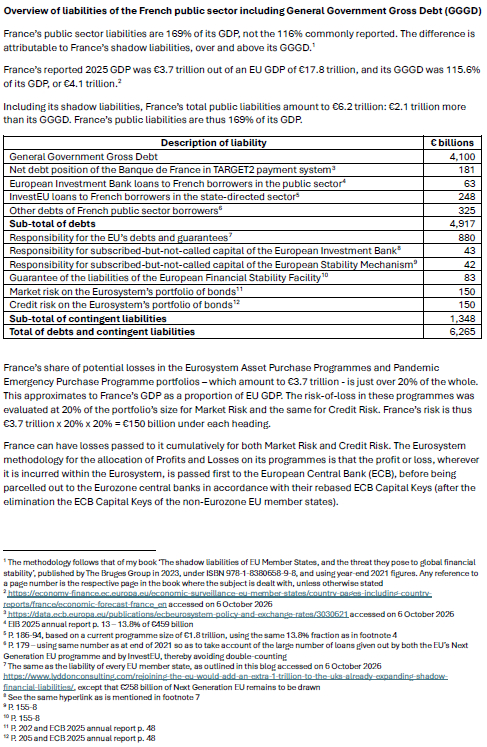
The above is a ‘ball park’ estimate of the total public sector liabilities of France, using the same methodology as was employed in my book ‘The shadow liabilities of EU Member States, and the threat they pose to global financial stability’, published by The Bruges Group in 2023, under ISBN 978-1-8380658-9-8, and using year-end 2021 figures.
The total, comprising debts and contingent liabilities, is 169% of France’s GDP.
If France came into a position where a programme of financial assistance proved necessary, its amount would have to assume that French public sector borrowers were locked out of public markets for at least two years. During that time all maturities would have to be rolled over, and the national fiscal deficit would have to be financed annually as well.
Assuming the debts have an average life of 7 years, €702 billion would need to be refinanced annually (€4,917 billion divided by 7).
The national fiscal deficit is 5% of a GDP of €3.7 trillion. That is an annual requirement for a further €185 billion.
That results in a need for €887 billion per annum and €1.8 trillion for two years. This figure should be regarded as a minimum, as the lock-out period from direct access to capital markets could be longer, and the total public sector deficit could be higher than the 5% of GDP at the central government level.
The European Stability Mechanism has nowhere near that amount of firepower.
The ECB’s Transmission Protection Facility, although supposedly unlimited in size, is earmarked for different purposes.
The solution must be to borrow the entire amount on the name of the European Union itself, for whose debts all EU member states are jointly-and-severally liable. This is the structure of the Coronavirus Recovery programme now re-named as Next Generation EU.
The EU can then buy €2 trillion of French public sector bonds over a 2-3 year period, without France going into any form of bailout.
It is the only possible solution as the EU and Eurozone simply cannot risk France – one of the two mainstays of the EU – becoming designated as ‘in bailout’. That would crash the European project. The credit ratings of all of the EU supranational entities would fall to the extent that none of their bonds would continue to count as ‘safe assets’. EU banks would then find that they were undercapitalised. The list of disasters would go on and on. It could plunge the Western world into deep recession, embolden Russia to more military adventures, deepen the divisions with the USA…
This is why my book spoke of these hidden debts and contingent liabilities as constituting a threat to global financial stability.
The other EU member states are just going to have to accept the logic of the arrangement they have become involved in, and suck up that they are dependent upon the recovery of France’s economy, upon its ability to service the €2 trillion of bonds that the EU will be buying, and upon a generalised national resurgence.