
Published on 5th August 2026
Have you noticed the new crop of financial institutions driving forward with headlong expansion in the North and Scotland under Labour, just as they did between 1997 and 2007?
From 1997 to 2007 it was the non-London banks and the major building societies, showing the sleepy laggards in the City how to achieve high growth.
Now it is public financial institutions, whose resources have been beefed up since 2024. They are directly funded with taxpayer money, as opposed to their predecessors, who only took it when they had gone bust.
Our public financial institutions are funded directly with our money, under Labour’s expanded ‘borrowing for investment’. These extra taxpayer liabilities can be hidden, because there are assets, and assets must be good, so the assets can be offset against the related debt within Labour’s new measure of national debt: Public sector net financial liabilities.
A nice financial conjuring trick, akin to the one used by New Labour’s non-London banks and building societies. The New Labour trick was that, because these institutions were lending on safe residential and commercial mortgages, with assets behind them, which must be good, and property prices only go upwards, the institutions could be exempted from owning a thick cushion of capital and liquid assets, and they merited no more than light-touch regulation. This all proved to be fallacious and to have enabled reckless expansion.
The obsession with devolution, as well as with burying history, means our public financial institutions are being built on top of New Labour’s financial corpses:
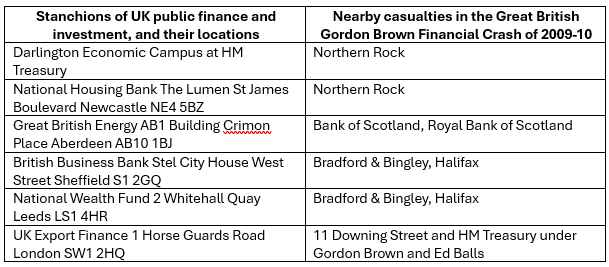
Both sets of financial institutions are channels for the realisation of Labour policies.
From 1997 to 2007 it was for rebuilding the Labour rust belt in the Midlands, North and Scotland.
Now it is for Labour’s Infrastructure, Industrial and Clean Energy Strategies…concentrating expenditure, at the behest of regional mayors and trade unionists, in the Labour rust belt in the Midlands, North and Scotland.
1997 to 2007 was the decade during which ‘the last Labour government offered stable politics alongside a stable economic environment’, according to Rachel Reeves’ 2024 Mais Lecture.
Now we are into Labour’s ‘decade of national renewal’.
1997 to 2007 was indeed a decade between New Labour’s election on 1st May 1997 and the date of 14th September 2007 when Northern Rock had to go for liquidity support to the Bank of England: a run on the bank with worried savers queuing down the street.
Northern Rock was the first collapse within the UK’s subset of the Global Financial Crisis: the huge bust that ensued from a massive boom in business volume without the capital, profits, and liquidity to sustain it.
The bust was a product of New Labour’s financial strategy: the claimed period of stability was the calm before the storm. Labour remained in power for a further three years while the economy was reduced to ashes, and they were able to diagnose the crash as having quite different causes while they were still squatting in power.
They would point the blame at Bear Stearns, Lehman Brothers, Americans generally, and globalisation, wouldn’t they?
We already have a foretaste of the bitter cup that the expansion of our Public financial institutions will proffer to our lips. The National Wealth Fund issued a £240 million guarantee in 2023 towards the other lenders into Gigaclear. Gigaclear ran into financial trouble and had to be bailed out. In that process the other lenders called the National Wealth Fund’s guarantee: the National Wealth Fund had to pay out £240 million to the original lenders, and became the direct lender to Gigaclear in their stead. Now the debt has had to be written off. The National Wealth Fund has become a part-owner of a failed company, and has lost upwards of £200 million.
What can we expect from Labour’s expanded Public financial institutions when they finally leave power?
Another colossal financial black hole needing to be filled with taxpayers’ money? Probably.
There are plenty of areas bereft of public financial institutions, though. Five regional slots still need filling with public financial institutions to get a ‘full house’ of disaster areas bequeathed by New Labour:

Get in there!