
Published on 1 October 2026
The UK’s financial liabilities have been steadily increasing, in addition to the cash actually being borrowed and spent by the UK government. These cash liabilities are our £3 trillion national debt, known as the Public Sector Net Debt.
There is a whole extra level of non-cash liabilities: guarantees, future spending commitments, liabilities for possible or real losses, and so on.
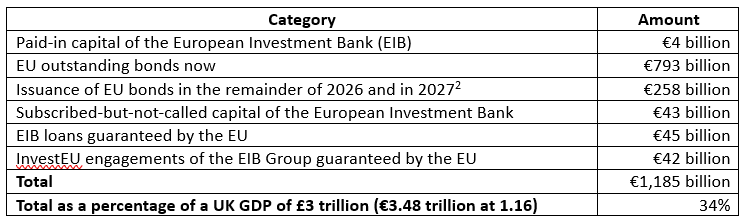
There is a bandwagon rolling for the UK to rejoin the EU and at the earliest opportunity. This would add a further £1 trillion to these non-cash liabilities.
£1 trillion equates to 34% of the size of the UK economy, mainly because the UK would become liable for all of the EU’s debts.
The headings are in the above table. You can download the full detail and the related risk profile through this link.
If the UK joined in time to participate in the EU’s 2028-34 budget round – its Multiannual Financial Framework or MFF – the UK would be walking into these additional liabilities of £1 trillion, on the very first day, in addition to a commitment to substantial payments of cash as a large, net contributor member state.
That would only be the start of it as the EU’s proposal to member states for the 2028-34 MFF envisages a considerable expansion of its expenditure programmes, its borrowing, and the taxes and levies it imposes on member states over and above their cash contributions.
In parallel the UK government is expanding our own stock of shadow financial liabilities – meaning liabilities that fall onto UK businesses and individuals but without their being recorded within Public Sector Net Debt.
These increases go beyond Private Finance Initiative (the costly residue of Labour’s previous period in government), public sector pensions, and the Bank of England’s losses on its monetary policy programmes.
The expansion derives from the government’s Infrastructure, Industrial and Clean Energy strategies, where projects take on colossal debts (in fact all of the funding is debt). One way or another it is the UK’s businesses and individuals who are being made responsible for these debts.
Under this heading the UK is being used as an experimental sandbox for how much shadow debt can be loaded onto a Western economy, and how much shadow taxation can be imposed on its businesses and individuals, before they collapse.
You can download the paper on this subject that Lyddon Consulting had published through the IREF think tank in the autumn of 2025 through this link.
You can download a summary of the main numbers in that paper through this link.
The outcome, even without the UK rejoining the EU, is frightening, but it is monstrous to contemplate the total amount that UK businesses and individuals will be made responsible for if the UK rejoins the EU.