
Published on 10th August 2026, reproducing an article written on 2nd April 2025
You can download this post as a document here.
Background
The enemy of the political Right is the nomenklatura – the extensive network of leftists appointed (by one another) for their political views, not for their competence, into the empire of patronage positions.
This is an extensive empire and it goes well beyond quangos, and right across civil society, to the extent that civil society and a genuinely private sphere can hardly be said to exist: all are defined as lying in the public sphere and subject to the purview of patronage positions.
Given the proliferation of bodies with boards requiring people to sit on them, there are too many positions for the talent available. So positions go to the talentless, and the public must be gaslit into believing that the resulting governance is good, when it palpably is not.
The gap between the gaslit version and the real version of UK public life is filled by bogusness, aimed at giving substance to what is vacuous: bogus credentials, bogus processes, bogus research, bogus representation, bogus support, bogus accountability…
Crisis point
We have a crisis of bogusness in UK public life.
It starts at the top, with cabinet ministers exaggerating their credentials, and it goes right down and across the hundreds of bodies through which public life is intermediated. These bodies are populated by a narrow and incestuous chumocracy, who select and re-select one another, exaggerating their credentials, achievements, and authority.
They are accountable to one another, not to the public, and that is no accountability at all: no one culprit will stand out from the crowd, and there is no penalty for personal under-achievement or for overlooking the same in co-members. If one of the members were to be weighed in the balance and found wanting, the others are implicitly weighed at the same time. That cannot be permitted, as it would threaten the entire edifice, in which the chumocracy accretes status and power to itself, and away from the public.
Campaigning and getting up a head of steam
One could be forgiven for imagining that there is no activity or topic experienced by a person in the UK which is not subject to a charity, trust, foundation, institute, or pressure group. An archipelago of organizations has been established, each one with its tentacles around its subject, and pumping out its drumbeat.
For the principal or principals of each organization the change they wish to bring about to that activity or topic can threaten to become the entire focus of their existence to the point of becoming an obsession.
When one marries that up with the available toolbox for attracting attention, magnifying support, faking credentialization and so on, one has the potential for issues to gain traction that are of no concern to the overwhelming majority of UK persons, and even to gain traction in a direction to which the majority of UK persons are opposed. Manufacturing concern and support for such a cause is the bread-and-butter of the campaigning groups that operate under many titles and guises.
Two examples will suffice of issues of almost no interest to the overwhelming majority of UK persons, but which have recently gained a high level of traction.
The first is Assisted Dying, a matter of apparently widespread public concern and requiring of immediate remedial action, that is as from the moment Esther Rantzen, the former BBC campaigner on consumer affairs, said so. Now it is driven through a Parliamentary process by an MP, Kim Leadbeater, in which controls, upon which the House of Commons’ approval to move to this stage of the process was predicated, are discarded.[1] Indeed, the ditching of a vital control is repackaged as an advantage, because ‘experts’ will be deciding instead of a judge, conveniently overlooking that a judge can be relied upon to operate within a restricted and accountable regime whereas a process within which ‘experts’ operate cannot be relied upon to be either watertight or accountable. Objections are arrogantly waived away, the process takes on a life of its own, the outcome is certain: Assisted Dying will go ahead. In the meantime, and with huge irony, Esther Rantzen has been spared from meeting her maker for long enough to be put on a new ‘wonderdrug’ which ‘may hold back her stage 4 lung cancer by months, even years’.[2]
The second example is Lucy Letby, the alleged unsafeness of whose conviction for murder is apparently of extreme public concern and requiring of an immediate case review, according to David Davis MP, who has used parliamentary privilege to pursue it.[3] That intervention – one for which he did not claim to have the support of the voters who elected him as an MP – failed, but failure did not deter. David Davis is not the MP for one of the constituencies affected by the Lucy Letby case, yet he seems simply to have taken it upon himself to get involved and use his position of power and influence to press in Lucy Letby’s favour, which cannot fail to be received negatively by the families, friends and acquaintances of the victims, and possibly by a significant portion of the general public. Has he obtained specific authorization from his constituents to involve himself in the matter and with the direction he has taken, or does he simply feel that because he is an MP he is entitled to involve himself wherever he likes and in whatever direction he chooses? Now a ‘panel of international medical experts’ has been assembled, and, not content with making an application through the existing legal channel, they lead off with a televised press conference.[4] The intention of that tactic is clear: to rouse media interest and public concern to press for a case review, whereas their application for one should stand or fall on its own merits.
These are the techniques ‘au courant’ for building up a head of steam, regardless of existing processes for handling the matter-in-hand, or the merits of a case. They are effective because they can be played into a pre-existing environment in which these techniques are the daily fare, and in which it has become difficult to distinguish between what is real, official, and copper-bottomed, and what is illusory, unofficial, and ill-founded.
Authorities themselves are to blame for the emergence of that environment and for its now being permitted to run riot.
Public life is increasingly run through arm’s-length bodies of appointees
The genesis of the problem is the increasing degree to which public processes are being devolved to bodies outside the Parliamentary process, bypassing any pretence at democratic accountability. This is far from just about quangos (quasi-autonomous non-government organisations) although quangos were the launchpad. Now this culture has developed a life and momentum of its own.
Bodies that have some degree of authority become indistinguishable from ones with no authority. Those with no authority adopt techniques to make it appear they do. Even ones that do have authority may enjoy it by inference as opposed to directly: there are a minimum of three tiers of bodies in operation and it takes effort to identify the tier in which any particular one sits, not least because bodies routinely attempt to make out they sit in a higher tier than they really do.
The bodies constitute a dense but extensive thicket, all requiring management and oversight, furnished in such a way as to support the pretence of authority and credibility.
Appointment, not election, is the method of admission to the ranks of the thicket.
Appointments are from the ranks of the chumocracy, exploiting rails laid down by the Tories and on which Labour are running a packed timetable of trains.
The Industrial Strategy Advisory Council is a recent example of the creation of a new Tier 2 body:
It has no statutory role, denying it Tier 1 status, so it has to be packed with figures from The Great and the Good to make up for that, with a sprinkling of Dames and Baronesses, and curated by Rachel Reeves and Jonathan Reynolds.
The UK’s nomenklatura run the show
Nomenklatura is the term from Soviet Russia that referred to a select overclass appointed for its political reliability and known world view, rather than for its experience in or competency regarding the subject area in hand.
The UK is ruled and managed by such an overclass, and what began as slots on company boards for Non-Executive Directors (NEDs) and a few quangos has spawned into an extensive archipelago of bodies and roles. These go far beyond traditional types of quango like the Arts Council and into the Care Quality Commission, NHS Trusts, governing bodies of schools and universities, charities, advisory boards, panels: it goes on and on.
Each one will have a dozen or so seats to be filled from this incestuous gene pool of like-minded individuals, detaching themselves unconsciously but inexorably from the society in which they live, and which they claim to represent. This does not widen participation but narrows it.
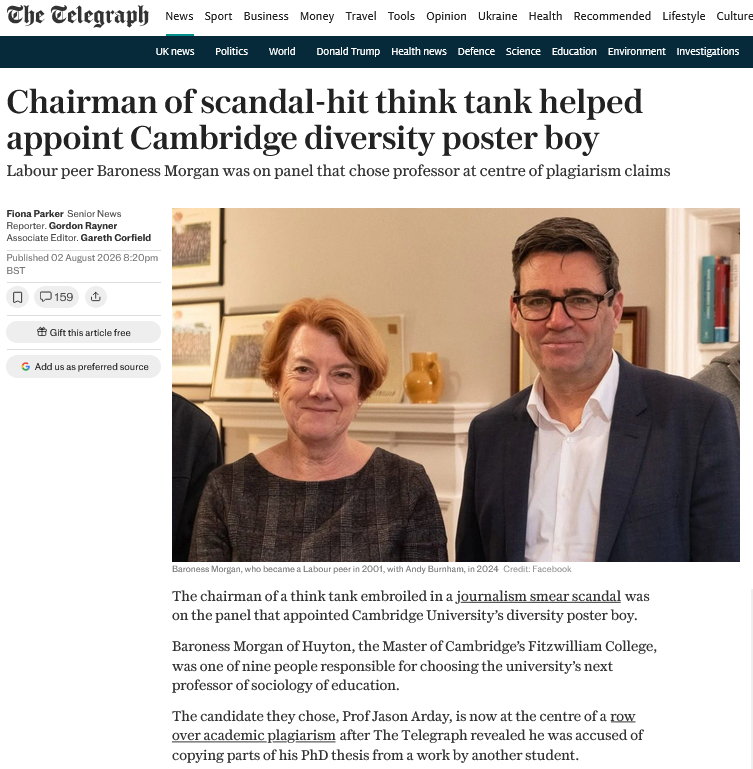
One minute Andy Burnham is being installed as an Honorary Fellow of Fitzwilliam College Cambridge by the Master, Dame Sally Morgan.[5] Baroness Sally Morgan was Director of Government Relations in 10 Downing Street from 1997- 2005, an appointment within the gift of Tony Blair and not requiring election as an MP.[6] Baroness Sally was appointed as a peer in 2001 and was appointed as Minister for Women and Equalities in the House of Lords. In addition to being appointed as Master of Fitzwilliam without having been an academic, let alone holding a PhD or a professorship, she was appointed to the Olympic Delivery Authority board for the London 2012 Olympic and Paralympic Games, as Chair of Ofsted, as vice-chair of King’s College London, as chair of or advisor to charities such as ARK, Ambition Institute and Frontline, as a trustee of the Education Policy Institute, as chair of the Royal Brompton and Harefield NHS hospitals in London (with no medical experience), to the boards of the Bennett Institute, the PTI (Professional Teaching Institute) and to the advisory board of the Centre for Science and Policy.
The next minute Andy Burnham is featuring the government’s plans to turbocharge UK investment by harnessing ‘the National Wealth Fund (NWF) and the Office for Investment (OfI), which will work with local leaders across the UK to support places to build pipelines of incoming investment and projects linked to regional growth priorities’. Andy Burham as mayor of Greater Manchester will be leveraging his non-existent track record in business and investment to ‘go much further and faster in support of the national growth mission. We particularly welcome the opportunity to work with Government to review the Green Book and how it is used to steer public investment, as the current approach is not working for the North of England’.[7]
Nomenklatura appointments result in non-diversity
Governing bodies become populated exclusively with nomenklatura who are 100% with the programme. Those that are not are burned off. The filling of vacant seats is controlled by nomenklatura writing the role descriptions and by sub-committees of nomenklatura overseeing the recruitment process. Where recruitment consultants are used, they are properly briefed as to what types of candidate make it onto the shortlist.
The result is governing bodies that are diverse in terms of the fields of activity in which the organisations have engaged on whose boards the appointees have sat. The list of organizations on which one particular nomenklatura has sat is given below: they cover an extraordinarily wide range of activities.
The governing body is ‘diverse’ in terms of the personal characteristics of its members when measured against a Diversity, Equity, Inclusion checklist.
The body is not at all diverse in terms of its members’ outlooks and opinions, or of the types of activities they have personally carried out. These activities – a daily round of meetings and Zoom calls – would not rank as ‘work’ in the eyes of 98% of the population.
Semi-resignation
Nomenklatura never really go. Before, like Tony Blair, they founded their own think tank and used that as their credential to continue to sit at the top table. Or else, like Mark Carney, you inhabit organizations like the World Economic Forum or the Financial Stability Board, where you can break bread with fellow globalists and Net Zero enthusiasts, although one felt that Carney’s Net Zero principles were cynical and opportunistic: it legitimised his global grandstanding and rubbing shoulders with his supposed peers up until a proper job came along.
Now, in addition, we see the usage of the device of semi-resignation: Justin Trudeau resigned in a fanfare but only, it later turned out, as head of his party, not as prime minister. This enabled him to continue as prime minister with full powers but under a lower level of accountability, not least because many must have thought that his powers would be diminished automatically or that he had already gone.
A further example is the Archbishop of Canterbury: resigned in early November 2024, still in post until mid-January 2025.
The device trickles down: the headmaster of Nottingham High School announced his intended departure around Christmas 2023, with the intention of remaining in post until mid-2025.[8] This has now been curtailed, as his project has hit the rocks, namely to convert this boys-only, fee-paying private school into a co-educational one in which ‘social mobility’ is the primary objective, and all the places are funded from a Bursary Fund. Unfortunately Labour have taken the plan’s legs off well short of its completion, with the imposition of VAT on the fees, and the school’s alumni – from the boys-only, fee-paying era – have not been sufficiently generous as to bankrupt themselves to bring the Bursary Fund up to the necessary capital of hundreds of millions of pounds.
Bogus credentialisation
How do you get onto this gravy train? It is an exercise in cramponing, starting at base camp and working your way up towards the summit. The intermediate camps are defined by the level of the body and of one’s role within it : the first step is get involved with a Tier 3 body in a modest role, and work your way along to more senior roles in Tier 3, then a modest role in a Tier 2, and up and up to the top of a Tier 1. It is not a question of moving on – you keep all the roles going until your diary is full.
If you have served enough time, you will get an MBE, KCB, OBE, CBE and some such other tin-pot medal, for which you will be nominated by another member of the gene pool. A panel of fellow gene pool members adjudicates the award. Once you have the medal you are credentialised to be appointed to further roles by further members of the gene pool.
The medal – obtained for whatever or for not doing much at all – replaces a proper credentialization through subject-specific expertise and achievements. The medal is a cosmic pass – it bypasses all the tedious acquisition of knowledge and experience, and gets you into organizations in any field, and straight into senior roles. One position leads on to others: the occupation of a role, regardless of what field it is in and regardless of personal performance in it, serves as the credential for appointment to another role.
There is no assessment of personal performance: the essence of these roles is sitting in judgement on others, not being subject to scrutiny yourself.
You may even reach the pinnacle – being nominated as Non-Executive of the Year, literally a medal for not doing work.
If that fails, one can always fall back on self-certification: claiming expertise, experience and qualifications that you do not quite have, to get your foot on the first rung on the ladder. The occupation of that rung is the qualification to go up to the next rung. Nobody in the gene pool will care that you are a fake: they all are too.
We have a credentialisation crisis in the UK, and it extends well beyond – but is perfectly exemplified by – Rt Hon Rachel Reeves (not an economist), Angela Rayner MP (not a carer) and Jonathan Reynolds MP (not a solicitor). Things only get dicey when people outside the gene pool interfere: accountability is within and between members of the gene pool (which is no accountability at all) and the door to non-members of the gene pool must be kept firmly shut. Unless, of course, they are willing to undergo the necessary and extensive gene adaptation therapy and become a conforming member of the gene pool themselves.
Example ‘career’
Baroness Sally Morgan’s CV is not unique. Here is another example of a single ‘career’, of multiple, simultaneous appointments of this one nomenklatura who was given a CBE along the way:
- Six years of communications and campaigning roles at Victim Support, Charter 88, and Liberty
- Chair, Fawcett, ‘the UK’s leading charity for women’s equality and rights’
- King’s College London, ‘Development Director at the Human Rights Act Research Unit’
- Chair, Independent Transparency Review Panel, a ‘review of the impact of transparency on privacy’
- Deputy Chair/Commissioner, Equal Opportunities Commission
- Deputy Chair/Member, Committee on Radioactive Waste Management
- Independent Director, Banking Code Standards Board
- Council Member, The Women’s Library
- Chair, Equal Opportunities Commission Great Britain
- Member, Advertising Advisory Committee
- Commissioner, Audit Commission
- Trustee, Charities Aid Foundation
- NED, WRAP, ‘WRAP’s vision is a world where resources are used sustainably’
- Chair, Electoral Commission
- Vice Chair, Citizens Commission on Islam, Participation and Public Life
- Vice Chair/Member Board of Trustees/Chair of Nominations Committee, Money Advice Trust
- Chair, Independent Complaints Panel, Portman Group
- NED, Financial Ombudsman Service
- NED/Chair Remuneration Committee, Financial Reporting Council
- Chair, Mossbourne Parkside Academy
- Chair, The House of St Barnabas
- Chair, GAMSTOP, ‘UK focussed gambling consumer protection tools’
- Senior Independent Director/Chair of Remuneration Committee, Reclaim Fund Ltd (sequestering dormant private assets and allocating them to good causes)
- Trustee, Norfolk Community Foundation
- Advisory Board member, ARC Club, a ‘group of neighbourhood work places’
- NED, Enforcement Conduct Board, ‘independent oversight body for enforcement agents (formerly known as bailiffs)’
- Vice Chair, Mossbourne Charitable Trust CIO, ‘education of current and future pupils of the schools forming the Mossbourne Federation’
- Chair, Broadland Housing Group, ‘high quality affordable homes’
- NED, Financial Services Compensation Scheme
Positions 23-29 inclusive are all held currently and on an ongoing basis; a post was put on LinkedIn in the week of 24th February that position 22 is being vacated. No doubt a new appointment will soon ensue: the CV is a little light in the universities sector.
There is some important stuff in this list of appointments – important to the nation and to the people in it – like the Electoral Commission.
What an incredible amount of power and influence this individual has accreted to themselves through ‘cramponing’, and with no direct, executive, hands-on experience of any of the activities that this person has been involved in. It is as if being a chair or being a NED were a profession in its own right, disconnected from the substance of the organization for which they act as chair or NED.
Would not one expect a commissioner of the Audit Commission to have an accountancy qualification, or someone on the board of the Financial Ombudsman Service or the Financial Reporting Council or Financial Services Compensation Scheme to have either a formal qualification or relevant hands-on experience in banking, insurance, or pensions?
Surely someone involved in decisions to do with managing radioactive waste must have some direct experience of the nuclear industry?
No need, apparently, but what an affront that is to the general public to have important roles, which safeguard the public interest, filled by someone who has not taken the time and trouble to learn the ropes, but is content to be hoisted in right at the top, and to receive a consideration for doing so. What an incredible sense of entitlement this person must have to accept these roles. What can one say about those who were involved in specifying the roles and selecting this person for them?
Where is the proof that the person’s tenure in any of these roles amounted to more than occupation? Where are the achievements-in-role, or are we looking at a culture where it is sufficient – indeed where it is preferred – to be ‘wozzer’ as opposed to a ‘didder’? Someone who occupied roles but achieved little whilst in occupation. No need for achievements-in-post, no performance appraisal, sitting in judgement on others without being subject to scrutiny oneself: where do I sign up?
What a huge number of organisations there are for such people to be involved with, and how much power and influence they collectively wield over public life.
Was there any contribution to the UK’s Gross Domestic Product in all of this?
It might be funny if it were not so frightening: so much power and influence exercised by nomenklatura, with every single seat being filled by mutual appointment from within the nomenklatura gene pool, and none by election.
Bogus naming
A number of practices have become current in maintaining this archipelago of bodies and their status and power, and we will start with bogus naming.
This is the naming of organisations to make them sound more established, more significant, and more ancient than they actually are. Tier 2 – a minor and/or arm’s-length authority body – tries to make itself sound like Tier 1, and Tier 3 tries to make itself sound like an authority body, or at least to give the impression of having an institutional status that is normally associated with authority, until you get the bonnet up and find it is not an institution or an authority body.
This last practice is notable where an organization’s name includes the word Institute, Trust, or Foundation, and these namings should be immediate indicators of bogusness.
Two concrete examples will suffice.
A Trust or Foundation infers venerability, reliability, and longevity. The name of The Runnymede Trust, a socialist think tank founded in 1968 by Jim Rose and Anthony Lester, infers a connection with the principles of Magna Carta, which was signed between King John and the barons at Runnymede.[9] Its address is Brickfields, 37 Cremer Street, London. It is a ‘private Limited Company by guarantee without share capital use of ‘Limited’ exemption’, which means that its real name is ‘The Runnymede Trust Limited’, but it suppresses the ‘Limited’ in order to project the impression of being something other than a private company.[10]
An Institute infers a professional standards body, one that issues the practice certificates for a profession, without which an individual cannot claim the title, set up a practice, or obtain professional liability insurance. The Institute for Fiscal Studies is not a professional standards body. Its naming infers that it is an authority body in its field, whereas it is just another private company limited by guarantee number 00954616, with ‘Limited’ left out of its name (although its Companies House entry does not state that it has been granted this exemption).[11]
Bogus promotion of authority and manufacturing of ‘evidence’
There are tried-and-tested techniques for slipping on the cloak of authority.
One is to become the secretariat organization of an All-Party Parliamentary Group (APPG). The technique kicks off by suggesting that there is a need for an APPG on the chosen topic to begin with. There are 600+ of them already. Once the proposing organization gets its APPG together and has itself appointed as the secretariat organization, it can issue its reports with the parliamentary portcullis on them, and generate newspaper headlines like ‘An influential group of UK Parliamentarians demanded a thorough investigation of the Financial Conduct Authority on Tuesday…’.
The APPG on Investment Fraud and Fairer Financial Services is run by Transparency Task Force, and indeed it was able to manufacture a headline like that. The APPG issued a ‘Report on the Call for Evidence about The Financial Conduct Authority’ with the parliamentary portcullis on every page.[12] The contents of the report demonstrate that it was arranged and curated by Transparency Task Force, rather than driven by the APPG members themselves, several of the quoted APPG ‘members’ having lost their parliamentary seats before the report was published.
The APPG arrangement permits the secretariat organization to purport to be an authority body, and to pursue its own agenda as if it were an agenda with wide public support.
An APPG also furnishes an opportunity for the secretariat organization to quote and promote the research of allied organizations, manufacturing the impression of a groundswell of public concern around an issue. There is ample opportunity within this nexus for the secretariat organization to recycle its own opinions, and to increase the degree of their authority: the allied organization issues a report that recycles the contents of a report issued by the secretariat organization. The secretariat organization quotes the report of the allied organization in its own outputs without referring to its own input to it, and promotes the result as ‘evidence’.
For example, The Runnymede Trust is the secretariat for the APPG on Race and Community. In the autumn of 2023, the APPG issued a ‘Call for Written Evidence’ on ‘Race and the Environmental Emergency’. Wildlife and Countryside Link responded, and on pp. 2-3 of its response it quoted ‘Research…from the Runnymede Trust [showing] that on average, people from ethnic minority communities within the UK are more affected by the climate and nature crises than White British people’. The Runnymede Trust then stated on its website regarding this exercise that ‘We gathered evidence to show racial inequalities at the heart of the environmental emergency’, without mentioning that this ‘evidence’ was partially based on its own ‘research’.[13] Nor did it provide any insight into the quality of the research, and in what measure it was composed of conjecture.
Note how ‘research’ becomes upgraded to ‘evidence’ during the recycling process. This is the process whereby a vague and preposterous hypothesis – that ‘on average, people from ethnic minority communities within the UK are more affected by the climate and nature crises than White British people’, when we all live together in a small and densely-populated island, and when we have had no ‘climate and nature crises’ in the UK during the period since there have been ‘ethnic minority communities’ – gets framed as research, then as evidence, and finally as a truth accepted with Parliamentary backing that guides public policy:
- Because there is inadequate challenge and scrutiny from the members of the Houses of Commons and Lords who are on the APPG;
- Because the secretariat organization is given a wide licence to wash its opinions through this machine.
Exaggeration and misrepresentation of support
Wildlife and Countryside Link exaggerates the degree of explicit support it enjoyed for its ‘written evidence’. It makes a general claim for its organization that it has ‘the support of over 8 million people in the UK’.[14] This is the supposed, aggregate membership of the 86 organizations that are members of Wildlife and Countryside Link: it would be interesting to know how many of the 8 million had even heard of Wildlife and Countryside Link, or had been given a chance to agree that the organization of which they are a member should become a member of Wildlife and Countryside Link.
In its response to the ‘Call for Written Evidence’ on ‘Race and the Environmental Emergency’, Wildlife and Countryside Link repeats the clam that it has the ‘support of over eight million people in the UK’ but it quotes only 11 of its 86 members as supporting its response, without going on to say that 75 of its 86 members had not explicitly supported the report. Nor does it trouble to shed light on how many of its supposed 8 million supporters were members of the 11, and how many were members of the 75. Since the 75 include names like Friends of the Earth, Greenpeace, and the National Trust, it is not beyond the bounds of possibility that the 75 account for 98% of the 8 million, and the 11 only 2%.
It would be interesting to know how many of the members of the 11 were aware that Wildlife and Countryside Link was going to respond to the ‘Call for Written Evidence’, and, of those that were, how many signified their support for the response explicitly. Were they even asked, or did the nomenklatura that run Wildlife and Countryside Link feel that they were entitled to take the support of the members of the 11, and indeed of the members of the 75, for granted, and to project that self-certified level of support into a Parliamentary process?
Of course it may have been felt that there was no need to liaise with the governing bodies of either the supporting 11 or the non-supporting 75 on this matter, since those governing bodies are packed with the same nomenklatura as Wildlife and Countryside Link itself.
Bogus representation and ‘advocacy’
Public processes are supposed to be inclusive and this gives an opportunity for nomenklatura to slide into the available spaces on committees and panels that are reserved, for example, for those who speak for small businesses and for consumers, as if either constituency could be validly spoken for by a single person. This fallacy sits at the heart of the concept of ‘advocacy’, which has come to mean individual people certifying themselves as authorised to speak for a given stakeholder group or constituency.
That fallacy – bogus representation – is an essential element in many public processes, because a tick in the box is needed from a constituency to whom the issue-in-hand may be important, and it is therefore necessary to bring about that tick and have it made by someone who can be positioned as entitled to speak for and commit the respective constituency.
Two examples of such committees will suffice.
The first one is the Bank of England’s Engagement Forum for a central bank digital currency. The Federation of Small Businesses sits on it to give the view of small businesses.[15] What is a small business? Is it a sole trader and/or a microenterprise and/or a ‘Small Enterprise’ as officially defined? It should not be a Medium Enterprise as officially defined. How many ‘small businesses’ are there in the UK? How many are members of the Federation of Small Businesses? Have the members of the Federation endorsed its membership of this panel? Have they been presented with the line that the Federation intends to pursue on this panel and, by approving it in a vote, issued the representative with a specific warrant as to what they are expected to do? Or was joining the panel a decision taken by the nomenklatura that run the Federation? And was there any warrant at all as regards the line to be taken? What about the views of all the other ‘small businesses’ that are neither members of the Federation nor within its criteria for membership? And yet the Engagement Forum is tackling a matter of high public importance with this one individual as the sole voice of the millions of business organizations in the UK that are not Medium-Sized or Large Businesses.
The second one is a more recent committee called National Payments Vision.[16] This committee has a cross-over with the Engagement Forum, in that there is a possibility that this committee may endorse a central bank digital currency as part of its National Payments Vision. Indeed there is a reasonable chance that it will, given that the members of all related committees are drawn from the nomenklatura gene pool.
There is a ‘consumer representative’ on National Payments Vision, who has also sat on panels like the Payment Strategy Forum, the Financial Services Consumer Panel, the board of the Payment Systems Regulator, and the Open Banking Implementation Entity. The same issues of authorisation apply: what consumers have endorsed this person to speak for them and on what terms?
Having such people speak for a constituency provides a weak voice for that constituency, which is intentional: a weak voice and a voice that is easy to co-opt behind what the sponsors want. The connection of the person to the constituency they represent may be tenuous: it is one person supposedly speaking for millions of businesses or tens of millions of consumers. But that does not matter if the box is ticked. An unpleasant bargain is made to get the box ticked, and one that is not in the public interest.
The involvement is attractive to the nomenklatura who is nominated: being appointed to this committee is a medal in itself and a passport to being on further panels, and possibly even a pathway to a CBE, MBE and so on. What’s not to like?
In exchange for these rewards the nomenklatura needs to be willing to serve the interests of the sponsor of the committee. Having the person on the committee allows the claim to be made that the committee is inclusive of the views of the constituency that the person is held out as speaking for. The sponsor can claim that the members of the constituency are bound to what was agreed. All the millions of members of the constituency have then unknowingly been co-opted into a way forward with which they may not agree, or even realise was being discussed.
All the nomenklatura has to do is not to raise any objections that are minuted (they are welcome to raise objections verbally as long as they agree to their being excluded from the minutes, as the objections do not formally exist if they were not minuted). The nomenklatura will be duly noted down as someone who delivers their constituency bound-and-gagged to the sponsor’s requirements, and can be relied upon not to rock the boat. Further appointments duly follow.
Advocacy and representation should be backed by a specific Letter of Engagement and a consideration per stakeholder group member of £10 (the minimum in law to create a contract). That protects the payer from the advocate purporting to represent them when they do not, and from the advocate pursuing a line in a forum contrary to the payer’s view. The advocate and the payer need to agree what is on the reservation, and the payer needs to have a channel of redress if the advocate goes off it. It is ironic that so many people are involved in purporting to represent the interests of the stakeholder groups and constituencies but without the normal redress which is the basis of consumer protection.
Where is the accountability? For example, consumer victims of Authorised Push Payment Fraud (APPF) after 2017 should have comeback against those who put themselves up as representing consumers and businesses in Payment Strategy Forum of 2015-7 and subsequently, and who endorsed Confirmation of Payee (CoP) as a mechanism for bringing APPF to a finish. CoP failed to fully protect against APPF and yet the same people who advocated it now sit in National Payments Vision and still purporting to represent the same stakeholders.
Leveraging the ‘Global Majority’ as the ultimate stakeholder group
In matters to do with race relations, advocates use the phrase ‘the Global Majority’ as a self-awarded authorisation to speak in the interests of ethnic minority communities in the UK, for example in the Diocese of Norwich Racial Justice Toolkit.[17]
The phrase ‘the Global Majority’ infers that there exists a unitary and settled body, which has a unitary and settled opinion. No such body exists and no attempt can be made either to poll its opinion, ask whether it wishes to be advocated for by whichever person is using the phrase, or whether the viewpoint that the advocate is adopting is agreeable to this non-existing body.
Nevertheless the usage of the phrase is potent unless it is challenged at source. Its usage elevates the arguments being advanced by the advocate to a level of supposed superiority and unchallengeability, on the grounds that they enjoy the automatic support of the majority of human beings everywhere.
This supposition attempts to force deference on all from the ‘Global Minority’, as if being in a minority automatically invalidates one’s claims and arguments on the grounds of the colour of one’s skin, and the colour of the skin of one’s forebears.
The supposition is backed up by a threat – of being cancelled as a racist. That threat is used to silence opposition.
Summary
So many topics and activities – so many bodies – so many obsessional people pushing for a given change to that topic or activity as if it were the front-of-mind issue for the majority of the UK general public.
The two examples under ‘getting up a head of steam’ were chosen to show how a narrow topic can be exaggerated in terms of its significance and support for it. These are topics that stand out because they have broken the surface of the water featured in parliamentary process.
The main subject of this paper is the many organizations that form a powerful undercurrent, and which exaggerate their credentials, authority, and support, and which amount to a uni-organization – because they are populated from the same nomenklatura gene pool.
This uni-organization does not break the surface of the water: it is the water, and it flows in a uni-direction. It is undiverse, and it enjoys horizontal cohesion: regardless of the topic-in-hand (which is the vertical dimension), the individual elements in the uni-organization adhere to a shared world view and set of priorities, and use the uni-organization to promulgate them over more and more aspects of national life.
We are entitled to enquire where the nomenklatura stand (the answer to which is where the uni-organization also stands) on the following, current political issues:
- Gaza;
- Brexit;
- DEI – Diversity, Equity, and Inclusion;
- ESG – Environmental, Social and Governance.
The fear is that the nomenklatura gene pool all stand in the same place on these political issues, that they unconsciously reinforce one another in their uni-position, that this credo is being imposed by them on a host of organizations in every conceivable field, and that contrary and diverse positions have been squeezed out through the process of mutual appointment.
If this is the case, we have a nexus of power in the UK not accountable to the general public that is promulgating a political agenda without control or oversight other than from within its own ranks, which is no control or oversight at all.
Conclusions – we are entering a dark tunnel
This promulgation involves bringing each element in the uni-organization onto a single ideological template, for which purpose the credos of DEI and ESG act as a useful toolkit.
This resembles the process undertaken by the Nazis after taking power called ‘Gleichschaltung’, which translates as ‘switching things onto the same basis’. It involved the bringing of the entirety of society’s topics and activities under state control, under the direction of state organizations, and operating under a single ideological template. What that meant was the expunging of ‘civil society’.
Compliance was attained via cancellation of individuals, often fatally, and by surveillance – of communication, action and thought.
Divergence was labelled – as Jewish, as Marxist, as Far Left.
Is this starting to sound familiar? The labels may be more and different – Far Right, Alt-Right, climate sceptic, racist, transphobic, Zionist – but the flavour is the same.
[1] https://www.bbc.co.uk/news/articles/c2egl17pvldo
[2] https://www.telegraph.co.uk/news/2025/01/01/esther-rantzen-assisted-dying-bill-regret/ accessed on 28 February 2025
[3] https://unherd.com/newsroom/david-davis-raises-lucy-letby-verdict-in-parliament/ accessed on 28 February 2025
[4] https://www.bbc.co.uk/news/articles/cvgl5yyg1x6o accessed on 28 February 2025
[5] https://www.facebook.com/fitzwilliamcoll/photos/last-week-fitz-alumnus-andy-burnham-mayor-of-greater-manchester-was-elected-by-t/1180077764127637/?_rdr
[6] https://www.governance.cam.ac.uk/committee-members/members/Pages/Sally-Morgan.aspx
[7] https://www.gov.uk/government/news/chancellor-unveils-plan-to-turbocharge-investment-across-the-uk
[8] https://www.nottinghampost.com/news/nottingham-news/nottingham-private-school-headmaster-steps-10035578
[9] https://www.runnymedetrust.org/about/about-us accessed on 27 February 2025
[10] https://find-and-update.company-information.service.gov.uk/company/03409935 accessed on 27 February 2025
[11] https://find-and-update.company-information.service.gov.uk/company/00954616 accessed on 27 February 2025
[12] https://www.appgifffs.org/ accessed on 28 February 2025
[13] https://www.runnymedetrust.org/partnership-projects/confronting-injustice accessed on 28 February 2025
[14] https://wcl.org.uk/our-members.asp accessed on 28 February 2025
[15] https://www.bankofengland.co.uk/the-digital-pound/cbdc-engagement-forum accessed on 27 February 2025
[16] https://www.bankofengland.co.uk/payment-and-settlement/the-national-payments-vision-committee-and-vision-engagement-group accessed on 27 February 2025
[17] P. 5 ‘Abbreviations’ in the downloadable pdf document under https://www.dioceseofnorwich.org/mission_and_ministry/mission/racial-justice/racial-justice-toolkit/