
Published on 21 September 2026
Introduction
It has become a new article-of-faith in the EU that Europe needs to reduce its dependence on Visa and Mastercard. This is justified in geo-political terms, on the supposed threat that the US President might decide to cut Europe off from the Visa and Mastercard systems.
The reverberation of this argument through the European corridors of power drowns out any discussion as to how it has come to this, and why Visa and Mastercard – despite their interchange fees being capped by the EU Interchange Fee Regulation EU751 of 2015 – have achieved market dominance.
Embarrassingly it is directly attributable to the way in which the European authorities themselves have intervened in the payments market to achieve their public policy objectives, driven by their opinions of what constitutes consumer protection. In doing so they have created their typical EU market: high regulation, high entry barriers, quasi-monopolies, and stagnation of the service at a level of low added-value.
These interventions – intermediated through private-public collaborative fora such as the European Payments Council – have added payments to the many industry sectors that are now state-directed. The results have brought the characteristics of the creations of EU authorities: reduced competition and innovation.
Calls for ‘EU payments sovereignty’
The recent call by Christine Lagarde of the European Central Bank (ECB) is typical of a current theme amongst EU functionaries.[1] The call is urgent for Europe to ‘reduce its dependence on Visa and Mastercard’.
Subsequent to that, as ITIF reported, the pre-existing European Payments Initiative (EPI) signed ‘an agreement with the EuroPA Alliance, a grouping of national payment schemes working to build interoperable alternatives to U.S. card networks, to create a continent-wide payment network connecting roughly 130 million users across 13 countries’. These figures are less impressive than they appear: the EU is 450 million or so people across 27 countries. ‘Continent-wide’ could mean participation from Cyprus, Portugal, Malta, and Finland.
EPI has existed for some time and has failed to make any genuine headway, with offerings like MyBank and Wero attempting to mimic the convenience of Visa and Mastercard, but failing to gain significant market penetration.
Visa and Mastercard are universally accepted by merchants, and are convenient for them to process, and near-risk-free. They appear to be cost-free for cardholders up to the point where, under a credit card, interest begins to accrue. They are not free for the merchant, and it is out of the amount of the sale that is not paid to the merchant that the card issuers are able to offer cashback and other cardholder benefits, and Visa and Mastercard are able to pay for their infrastructure.
Where the EU’s problems stem from
The EU’s problems stem from their approach to converting member state-level payment systems to EU-wide ones, and specifically to support Economic and Monetary Union i.e. to support the Single Market and the euro.
Visa and Mastercard already existed in a reasonably harmonised form before the euro was introduced in 1999, and the cards domain was viewed at that time as successful and representing a ‘market model’ to be emulated in the area of ‘payments’, which the EU defined as referring to credit transfers and direct debits, as opposed to card payments.
The EU’s strategy was also influenced by the mandate of the ECB, its independence, its remit to deal with all payments deemed ‘systemically important’ (and therefore related to financial stability), and the consequential fact that the ECB already had an EU-wide payment system in place as of 1/1/1999 to deal with systemically-important payments in euro, called TARGET (which has now been upgraded to TARGET2).[2]
Systemically-important payments were ruled out-of-scope of the EU’s strategy, which then concentrated on core-and-basic payments, otherwise referred to as low-value payments, in the form of credit transfers and direct debits.
The EU’s strategy resolved itself into a demand that all the legacy low-value payment instruments and payment clearing systems in Eurozone member states must be collapsed, and that EU-wide instruments must be used instead. These legacy instruments and systems had been redenominated from their legacy currencies into euro on 1/1/1999, but this was not enough: harmonised EU instruments and systems must replace them.
This project is known as Single Euro Payments Area, or SEPA.
Market model
The SEPA market model calls for the separation of the credit transfer and direct debit markets into layers, where actors should compete with one another in some layers and collaborate with one another in others. In a Public/Private Partnership model as has become common both in the EU and UK, public authorities would set out the guidelines and applicable laws for the model’s realisation, and private market actors would construct and run it:
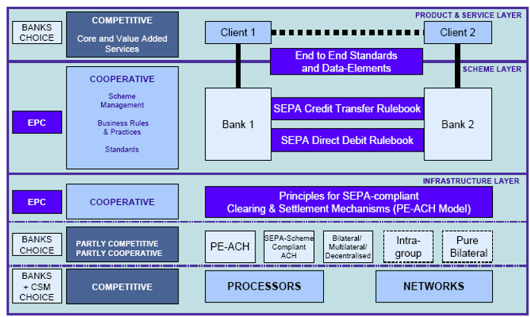
The concept is of ‘payment rails’ being constructed cooperatively between market actors, and of market actors then using those rails to build competitive services on them.
There are two types of competitive actor:
- Payment service providers who offer payment services to payment service users; and
- Payment clearing and settlement systems who offer clearing and settlement services to payment service providers.
The cooperative space is responsible for:
- Designing the payment service instruments themselves;
- Creating and maintaining a rulebook for their usage;
- Creating and maintaining technical specifications for the messages that enable the rulebook’s terms to be fulfilled.
The SEPA services should be available everywhere in identical form and at very low cost for the payment service user, and incorporating strong protections for the user. Payment service providers should be able to have a free choice of which supplier of clearing and settlement services to use, and every payment service user should be reachable from every payment service provider, without intermediary correspondent banks needing to be identified. To achieve that the clearing and settlement systems need to be interlinked, and to be ‘interoperable’ with one another.
What is ‘low-value’?
Given the scope of the project – low-value, core-and-basic payments – it was decided that the timing of a SEPA payment should initially be two days (known as D+2), with the payee receiving money they could use two business days after the payer had given their payment order to their payment service provider.
This proved to be a fatal error in competing with Visa and Mastercard, whose transactions complete instantly for the payer and payee, albeit that the payee initially receives a ‘payment guarantee’, with the funds following one or two days later. The payee regards the guarantee as good enough to perform services or release goods straight away against it. The difference between ‘payment’ and ‘payment guarantee’ is why Visa and Mastercard were termed as ‘near-risk-free’ above, rather than ‘risk-free’.
It was also decided that a payment of €12,500 or below ranked as ‘low-value’, an arbitrary level of little relevance to payment service users.
Transition plan
The first step was for the payment industry to establish its own quango to oversee the transition: the European Payments Council, a self-regulatory body, set up so that the industry should not simply be facing a series of EU Regulations to deliver upon.[3]
Nevertheless the timeline was indeed dictated by EU regulations and directives. The EU was driving the market with its regulatory vision, whilst the voluntary take-up of the SEPA schemes by customers was slow, not least because they offered no value when measured against the legacy national schemes they were meant to replace. Those schemes were embedded at customers, and there was an investment to transition, without a business case to justify it. The main proposition of the SEPA schemes – that they could be used for cross-border payments in euro to the entire EU as well as for domestic ones – had no pull for the many customers whose payments were predominantly or even totally within their own member state, public authorities being notable amongst them.
To hurry the SEPA transition along, and to pursue its own vision, the EU imposed the following regulations and directives, which dominated the agendas of EU payment service providers from 2001 until 2020, leaving little or no space for other initiatives. The main regulations and directives were:
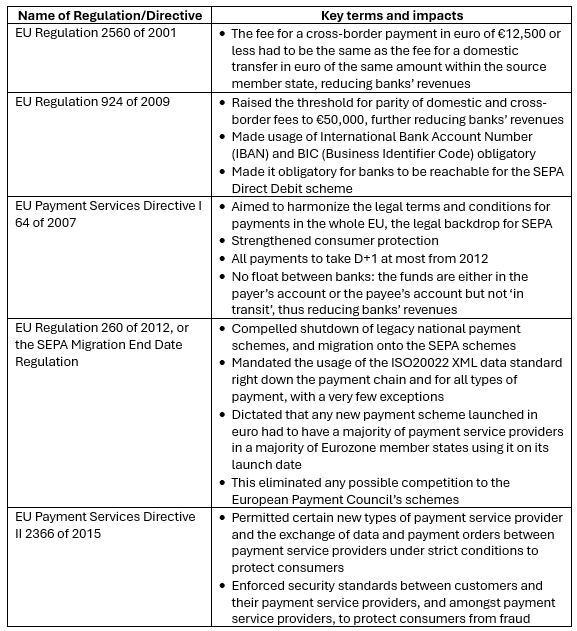
The European Payment Council’s rulebooks and technical guides were updated every November, in order to facilitate that the SEPA schemes become compliant with each piece of legislation as it was issued.
No space for new products and services
Given that the SEPA Migration End Date Regulation conferred, via the mechanism of a high entry barrier, a de facto monopoly on the European Payment Council’s schemes, new services could only be developed within the confines of those schemes.
That meant within the confines of the ISO20022 XML messages that were the only permitted technical medium. The European Payment Council’s technical guides reserved many fields in the messages for their schemes, and forbade the usage of others as incompatible with the principles of SEPA (such as fields catering for chains of correspondent banks).
Several of the remaining fields were earmarked by the banking associations of individual member states to carry data that their legacy national schemes used to carry, but which were not catered for in the European Payment Council’s SEPA schemes. This data became known as ‘Community Value-Added Services’.
It was forbidden for market actors to use a field in ISO20022 XML for a purpose other than that laid down at a global level through the ISO process e.g. using a field originally designed to carry correspondent bank information instead to carry codewords that triggered special treatment of the payment at the receiving payment service provider.
It was only possible under very limited circumstances for groups of payment service providers to set up private arrangements and even then they were compelled to operate in a SEPA-compliant manner, registering themselves as a SEPA Clearing and Settlement Mechanism, opening to membership to other payment service providers, and following the SEPA rules and technical specifications in their operations, and by implication following the ISO technical specifications (of which the SEPA technical specifications were a version).
The result was that the possibilities to develop new ‘Competitive’ services in the layer called ‘Banks Choice’ in the market model – referred to there as ‘Value-Added Services’ – were limited almost down to nil. Indeed, none have emerged. The ‘Core’ service remains the only version.
Even were there space in the messages, the investment case for ‘Value-Added Services’ is undermined by the time and process of bringing it to market. The process of checking that the field is available for usage must be passed through the mechanisms of the European Payment Council, thereby both divulging the plans to the entire market, and imposing a long lead-time-to-market.
Then there are the risks of using a message field that is not permanently reserved. The checking process does not permanently reserve the field for a ‘Competitive’ actor, as it does for a ‘Community’ actor (like a member state banking association) or for the European Payments Council itself. Even if the service were to be developed, its sponsor has no certainty that later on a future version of the European Payment Council’s schemes will not embrace the field the sponsor has used. If it does, then not only does the sponsor have to invest again to abolish their own Value-Added Service, but also to invest yet again to replace it with the extension of the Core-and-Basic service as dictated by the European Payment Council: a triple investment simply to end up with compliance on a basic service which every other market actor has.
Innovation does not take place. No new competitor products emerge. All payment service providers are offering the same product and almost for free, because price becomes the only basis of competition.
Characteristics of the Eurozone payments market
The result is a parallel running of the Visa/Mastercard ecosystem, and the European Payment Council’s ecosystem. The latter is monopolistic: no new schemes can emerge. It also defies innovation. Competition cannot be on functionality: it can only be on price. The service contains no added value, so indeed the correct price for it is zero.
The result is no investment that is not obligatory, and no time and space to invest anyway. There are annual upgrades to all the scheme rulebooks and technical manuals. These have to be implemented at the same time as any global changes to ISO20022 XML which are issued through SWIFT, and which also apply to the TARGET2 high-value payments system of the ECB. That takes up a large portion of the IT resources allocated to the payments business of a bank. These resources are kept to a minimum because the returns on investment in this kind of payment service are low.
The upshot is a stagnant, low-return market, from which no major player is permitted to exit, but which involves a high cost and a high effort level to participate in it.
That is an avatar of the EU economy as a whole.
Summary and conclusions
EU authorities calling for a competitor to Visa and Mastercard and referring to geo-political reasons is a distraction technique.
Visa and Mastercard have been successful because they offer Value, under the equation of Price + Performance = Value.
The EU’s own attempts have resulted, under that equation, in a cheap product which has been effectively static in its functionality for 18 years whilst the world has moved on around it. The product has remained core-and-basic, and no ‘Value-Added Services’ have emerged on top of it. The consumer, however much they have become protected, sees more value in Visa and Mastercard.
The EU’s way-of-working ensures timelines are measured in years. The Public/Private Partnership has shown itself to be a methodology that adds time and complexity but not value.
The EU’s response is true-to-type: more ‘initiatives’ and, no doubt, further regulations and directives.
The EU payments market has become an archetype of the Single Market and the Eurozone. The exception is Visa and Mastercard, so fault must be found with them, however spurious the reasoning, and they must be taken down.
[1] https://itif.org/publications/2026/03/24/europe-payment-sovereignty-campaign-against-american-tech/ accessed on 2 July 2026
[2] All EU member states were obliged to run a payment system for systemically-important euro payments interlinked to TARGET as of 1/1/1999, whether the member state adopted the euro or not. The UK’s version was CHAPS-euro
[3] https://www.europeanpaymentscouncil.eu/ accessed on 2 July 2026