
Published on 27 September 2026

Introduction
Amidst great fanfare the European Union (EU) pulled out an offer of Associate membership to Canada upon the occasion of the recent visit of Mark Carney, Canada’s Prime Minister, as reported by the BBC in the article featured.
Little further explanation was given of what this offer entailed. An Associate membership of any organisation lowers the rights and obligations of the Associate compared to those of a full member. Yet the outcome must result in additional value for all parties: the organisation, its full members, and this first Associate and any future ones.
Given that the EU aims at Economic and Monetary Union, and has defined – and continues to refine and expand – what each member needs to do in order that this be achieved, there is a basic incompatibility between the EU model and an Associate membership category within it.
The author ran a successful Associate membership programme for the IBOS Association banking club between 2003 and 2016.[1] This programme enabled an IBOS customer to open bank accounts and obtain services in 27 countries at its maximum, countries that represented over 70% of global Gross Domestic Product and an even higher percentage of the world’s open economies.[2]
An explanation of the drivers and components of the IBOS Associate membership programme will demonstrate why the EU’s offer to Canada is nonsensical, and potentially lethal to itself.
What was the purpose of IBOS
IBOS was a network of banks who needed to extend the reach of their international operations in order to service their corporate customers. IBOS was a model whereby the technology, processes, and organisation that a bank would use to interact with its own foreign subsidiaries were leveraged to enable interactions with other IBOS member banks: the aim was a harmonised international service over a large geographical area, delivered, for any one member, through its own foreign subsidiaries and its IBOS partner banks.
The barrier that the Associate membership network enabled IBOS to surmount
Up until 2003 a bank had to join IBOS as a full member, or not join at all. The investment for full membership – in staffing, organisation, and technology and operational capabilities – was in the region of USD3 million to develop compliance with the complete service scope and service level, and USD1 million per annum to maintain compliance.
That was a turn-off for banks in medium-sized and small economies. At the same time the existing members wanted those countries included in IBOS’ coverage because their customers had operations there.
There needed to be a lower-cost entry-and-maintenance model to obtain wider geographical coverage, while still delivering the key elements of the IBOS service level. This was the Associate programme.
Resultant membership structure
- 12 or so full member banks located in major economies and ones in which international corporate companies had their headquarters
- 15 or so Associate members, in countries where international corporate companies had subsidiaries and active trading, but where few had their headquarters
- Associate members were both full-service banks and subsidiaries of full members, who sponsored them into the network
Full Membership rights and obligations
- Pay the membership fee that covered the costs of the IBOS secretariat
- Appoint a Board member
- Maintain a customer service operation for all exchanges of business between themselves and the Associates they had sponsored in on the one side, and the other members and their respective Associates on the other
- Treat applications for customer accounts in line with the IBOS Account Opening Agreement
- Make and receive IBOS payments in USD and EUR in near-real time
- Adhere to the IBOS service level for the production of account statements during the business day and as of end-of-day
- Support the IBOS end-of-day cross-border sweeping service in EUR, known as DZero, as both the bank out of which funds are swept, and as the bank into which funds are swept
- Raise a claim against another member – Full or Associate – for failure to adhere to an IBOS service level on their own behalf and if one of their sponsored Associates was affected
- Supply contact and operational information to the IBOS Secretariat so as to enable all the other participating banks to operate the IBOS services with them and their Associates
What an Associate member does not have to do and why
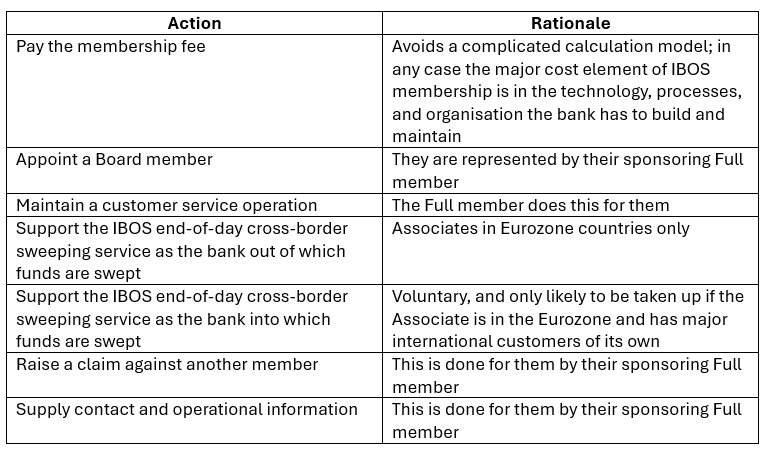
Restrictions affecting both Full and Associate members
Restrictions should be limited to ones required to deliver the IBOS service level, which had to be competitive, differentiated, and offering points of added value.
Operational and technology points of added value came down to capabilities and treatments over and above what a member bank was obliged to do anyway, at two levels:
- The level of belonging to the SWIFT network and installing the obligatory annual upgrades;
- The next incremental level of assisting their own corporate customers in their international business, and of banking foreign-owned customers in their own country, using messages in the SWIFT message book that were not connected to interbank accounts and payments.
In effect, IBOS existed to enable its members to offer a superior service to the one that virtually any bank could offer by implementing SWIFT messages, in a basic manner, under this level 2 increment.[3] An IBOS-specific investment had to track exactly on to an enhancement to the customer experience above what was possible under this level 2 increment.
Comparison of IBOS model with the EU
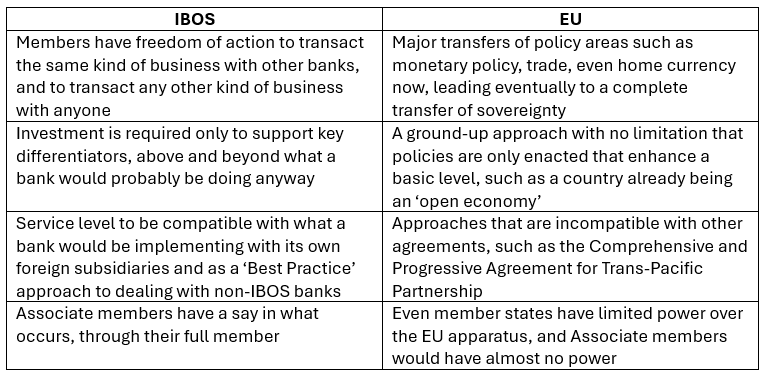
The EU’s objective is to become a nation state of a size equivalent to China and the USA, as route to wealth and geopolitical importance. That sets an extremely high bar, and is an objective normally triggering a response of ‘I’m in’ or ‘I’m out’, and not one of ‘I’m half in and half out’, or ‘I’m in this one, and in this other one as well’. These two latter responses are germane to an Associate membership model, and must be perfectly acceptable – or else the respective Associate membership model is misconceived.
This is where an Associate membership status in the EU is misconceived compared to the same status in IBOS:
Summary and conclusions
Unlike the IBOS model, the intrinsic nature of the EU model precludes the concept of an Associate member. The EU is a maximum harmonisation model imposing high obligations on a member, inhibiting their freedom-of-action in extensive areas of public policy, and resulting in a high cost-of-membership in terms of investment to comply with EU law-giving.
Like IBOS, however, the cash cost of EU membership – which for many member states is actually an income – is by far not the only component in the package of obligations that membership entails.
There simply cannot be an Associate member of an organisation like the EU.
There is also a danger: a number of existing EU member states might decide that Associate status was more attractive to them than full membership, if the requirements were dropped low enough and the benefits remained substantial enough to constitute an attractive package for Canada.
Existing members might then opt out of full membership and into Associate status, notably those outside the Eurozone. This outcome would be a very neat way of the EU shooting itself in the foot, giving up on its vaulting ambitions, and effectively disbanding itself. One should not underestimate what Ursula van der Leyen is capable of, in a negative sense.
[1] https://www.ibosassociation.com/ accessed on 23 September 2026
[2] The concept of an ‘open economy’ does not mean that countries had to have a free trade agreement between them, but at least there had to be a preponderance of elements supporting cross-border business and trade, such as the currency had to be convertible, there was no exchange control regime, foreign companies had the right to invest there, non-residents were permitted to maintain bank accounts either in local currency or USD
[3] Principally by implementing the MT101 Request for Transfer message, the MT940 Customer Statement message, and the MT942 Interim Transaction Report message, each one to a basic level